INsights

That model is breaking — and most businesses haven’t caught up yet.
If your website appeared at the top of Google, you won. Traffic increased. Leads followed.
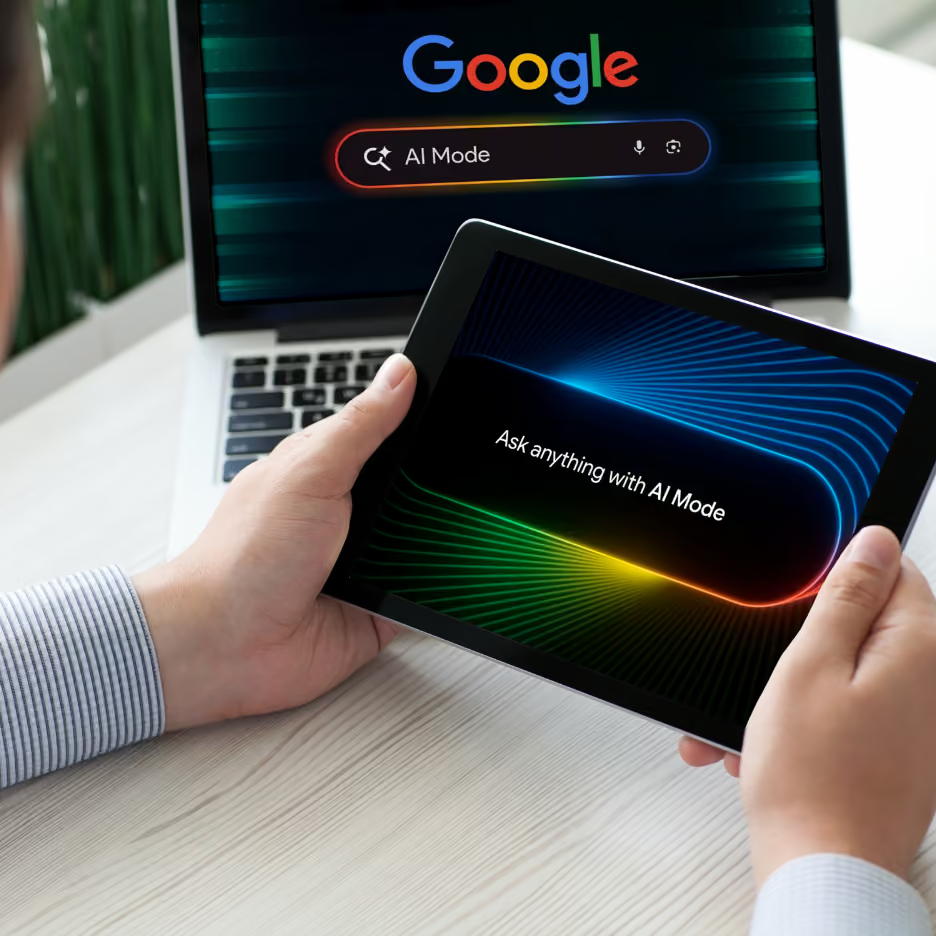
But search behaviour is changing rapidly. Today, many users no longer scan lists of blue links. Instead, they receive AI-generated answers summarising multiple sources directly in the search interface.
This shift is redefining how visibility works online. The question is no longer “Do you rank?”
It’s now “Does AI mention you?”
That’s where Generative Engine Optimisation (GEO) comes in.
Modern search experiences increasingly rely on AI systems that synthesise information rather than simply listing websites.
Examples include:
These platforms generate complete answers by analysing and combining information from multiple sources across the web.
For users, this creates a faster experience. Instead of opening several pages, they receive a structured response immediately.
For businesses, it introduces a new challenge.
Your content may be read, summarised, and used by AI — without a single click to your website.
Traditional SEO focuses on three main outcomes:
But AI-powered search changes how users interact with results.
Because AI summaries often appear above traditional organic listings, users may find answers without ever scrolling further down the page.
That means a website could still rank highly but receive less traffic and fewer interactions.
We’re already seeing this in analytics — impressions holding, clicks dropping.
Visibility now depends on something different: being included in the answer itself.
Generative Engine Optimisation (GEO) is the practice of positioning your brand and content so AI systems reference or cite it when generating answers.
GEO shifts the goalposts from ranking pages to becoming a trusted source AI systems draw from.
It focuses on helping AI platforms:
In practical terms, GEO means your brand becomes part of the knowledge AI draws from, rather than just another search result.
Millions of users now begin their research directly inside AI tools.
Instead of searching “best CRM software”, they ask a conversational question like:
“What CRM should a small B2B company use?”
AI systems analyse multiple sources and provide recommendations.
If your brand appears in that response, you gain visibility even if the user never visited your website.
AI-generated answers often include:
Being included in these responses shapes perception and credibility.
Users often treat AI summaries as trusted guidance, especially when the answers reference multiple sources.
This means your presence in AI outputs can influence decisions long before someone reaches your website.
Traditional SEO focused heavily on optimising a single asset: your website.
AI systems work differently.
They gather information from many sources, including:
Strong GEO strategies therefore expand visibility beyond a single website.
The goal is to build consistent authority across the web, making it easier for AI systems to understand and reference your brand.
AI systems don’t read pages the way humans do.
They retrieve specific passages or data points that answer a query and assemble them into a response.
Content is more likely to be used when it includes:
This structured approach helps AI systems extract information accurately and attribute it to a source.
Despite the changes, traditional SEO still matters.
Strong SEO foundations remain essential because they help AI systems:
In other words:
SEO builds the foundation. GEO extends visibility into AI-driven search.
Businesses that already produce high-quality, authoritative content are better positioned to benefit from both.
To remain visible in an AI-driven search landscape, businesses should prioritise:
Publish content that answers real buyer questions clearly and directly — not just optimised keywords.
Use headings, summaries, lists, and clear explanations to make content easy for AI to extract.
Mentions in credible publications, reviews, and industry discussions strengthen trust signals for AI systems.
Author bios, credentials, and credible citations help establish Experience, Expertise, Authoritativeness, and Trust (E-E-A-T).
These signals influence whether AI systems choose to reference your content.
Search is evolving from a link discovery system to a knowledge synthesis system.
The brands that win will be the ones AI trusts — and most businesses haven’t built for that yet.
That means consistently demonstrating:
This is the shift from ranking in search results to appearing inside the answers themselves.
And in the emerging AI-driven search landscape, being referenced often matters more than being ranked first.